 California Construction Loans
 › Blog › How Does a California Construction Lender Evaluate a Proposed Home’s Completed Value?
← All articlesHow Does a California Construction Lender Evaluate a Proposed Home’s Completed Value?
Key takeaways
- As-completed value is the appraiser’s prospective opinion of what the documented finished home would sell for in its market.
- Construction lenders commonly limit the loan using the lower of their value-based and cost-based limits, then apply credit, reserve, and completion-risk requirements.
- Construction cost does not equal market value; expensive site work and personalized upgrades may not add value dollar-for-dollar.
- Final plans, detailed specifications, realistic bids, permits, and site-risk reports make a completed-value analysis more reliable.
- Fannie Mae postponed-improvement thresholds are program-specific and are not universal California construction-loan rules.
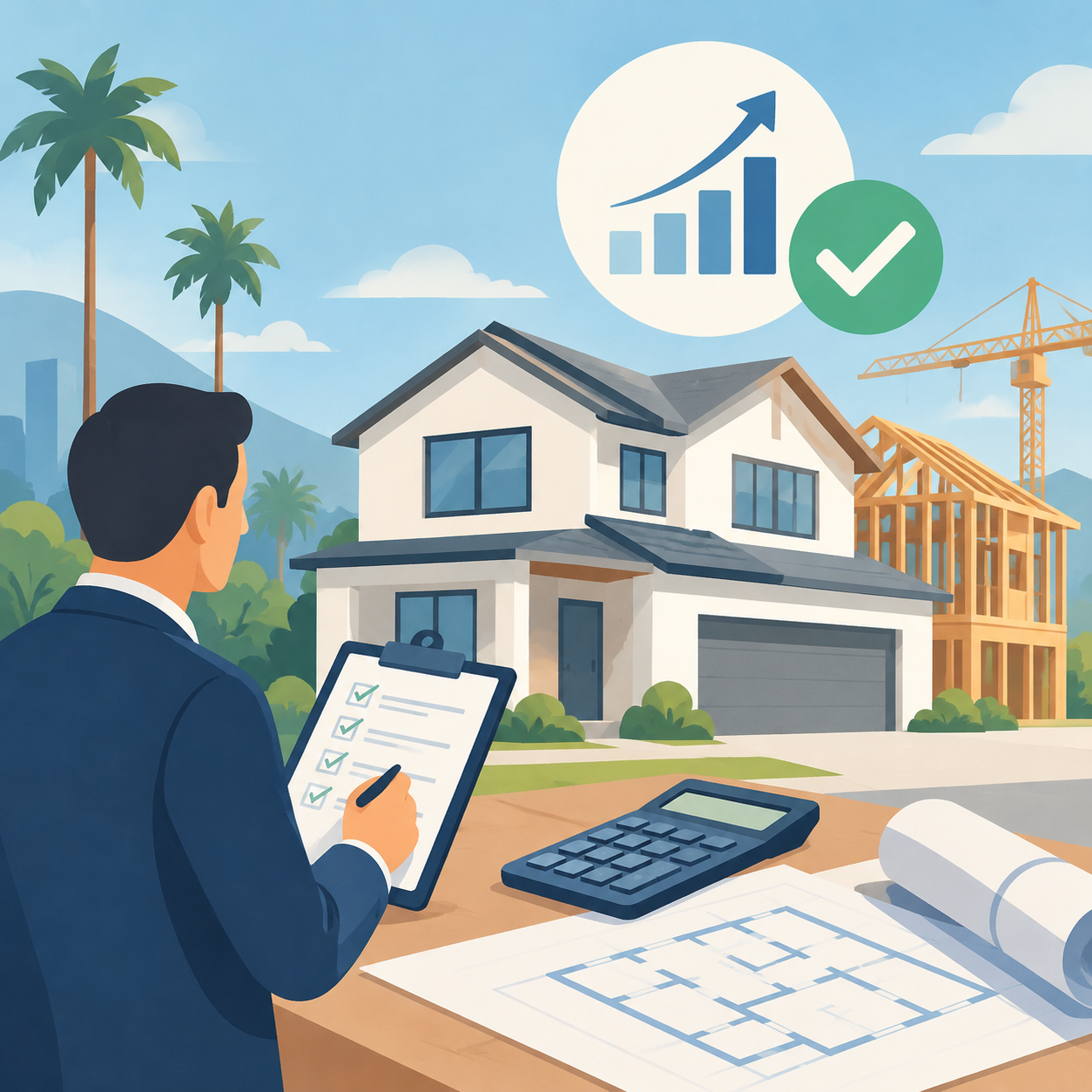
A California construction lender evaluates a proposed home by estimating its as-completed market value—what a typical buyer would likely pay once the documented plans are fully built. The lender then tests that value against the construction budget, borrower equity, site risk, permits, contractor capacity, and the proposed loan-to-value and loan-to-cost limits.
The Short Answer: Value Comes From the Market, Not the Budget
A completed-value analysis answers one central question: If this exact home were finished today, would its market value support the requested loan?
The answer is not simply land value plus construction cost. A borrower may spend $1.2 million building a home, but if comparable buyers in that location pay only $1 million for similar completed homes, the lender will generally underwrite closer to the supported market value—not the amount spent.
For a construction loan, the lender usually considers two collateral benchmarks:
- As-is value: The current value of the land and any existing improvements before construction.
- As-completed value: The appraiser’s prospective opinion of market value after the proposed work is completed according to the plans and specifications.
Federal banking guidance recognizes prospective market value for construction lending when the appraisal clearly identifies the property’s proposed condition and the assumptions used to reach that conclusion. See the Interagency Appraisal and Evaluation Guidelines.
The Lender’s Core Calculation: Value, Cost, and Equity
Construction lenders normally do not use one number in isolation. They compare the loan request against both value and cost.
A simplified underwriting framework looks like this:
Maximum loan = the lower of:
1. Maximum permitted LTV × as-completed value
2. Maximum permitted LTC × eligible project cost
3. Amount supported by borrower credit, reserves, and repayment ability
LTV means loan-to-value. LTC means loan-to-cost. Neither is a universal California percentage; portfolio banks, credit unions, private lenders, and construction-to-permanent lenders set their own policies.
Illustrative California custom-home example
Assume a borrower owns a lot with an as-is appraised value of $500,000 and proposes to build a 3,200-square-foot home.
| Item | Illustrative amount |
|---|---|
| Current land value | $500,000 |
| Hard construction cost | $900,000 |
| Soft costs, permits, engineering, insurance | $180,000 |
| Contingency reserve | $90,000 |
| Total project cost | $1,170,000 |
| Appraiser’s as-completed value | $1,450,000 |
If a lender permits 75% LTV and 80% LTC, the preliminary limits would be:
- Value-based limit: 75% × $1,450,000 = $1,087,500
- Cost-based limit: 80% × $1,170,000 = $936,000
In this illustration, the cost-based limit is lower, so the maximum preliminary loan would be $936,000, before the lender considers income, credit, reserves, liens, and other loan conditions. The borrower would need to contribute the balance through cash, documented land equity, or both.
This example also shows why a strong appraisal does not automatically produce a larger loan. The lender may still limit leverage based on the budget, risk profile, or borrower’s ability to carry the project if construction runs late.
What “As-Completed Value” Actually Means
As-completed value is an appraiser’s opinion of the property’s market value in its planned finished condition, subject to completion of the stated work.
The appraiser is not valuing a vague concept such as “a luxury house.” The assignment should identify the specific property that will exist at completion, including:
- Gross living area, bedroom and bathroom count, and garage capacity
- Floor plan, architectural style, ceiling heights, and functional layout
- Construction quality and finish level
- Kitchen, bath, flooring, appliance, HVAC, and energy-efficiency specifications
- Pool, accessory dwelling unit, guest house, outdoor kitchen, decks, or landscaping
- Lot size, slope, views, privacy, access, utilities, and drainage
- Zoning, legal use, permits, and other factors affecting marketability
For a proposed-construction appraisal, final or near-final plans matter. An appraiser cannot reliably estimate value if the documents say “premium finishes” without identifying whether that means builder-grade quartz, natural stone, custom millwork, or imported fixtures.
How the Appraiser Builds the Completed-Value Opinion
The appraiser typically uses the sales comparison approach as the primary method for a one-unit residential home. That means comparing the proposed finished home with recently sold properties that buyers viewed as reasonable substitutes.
The appraisal may also consider active listings and pending sales to understand current competition, although closed sales generally provide the strongest direct evidence of what buyers actually paid.
What makes a comparable sale credible?
A strong comparable is not merely nearby or similarly priced. It should be similar in the attributes that drive buyer behavior in that micro-market:
- Similar neighborhood, school-market influence, and access to employment or amenities
- Similar lot utility, topography, view orientation, and privacy
- Similar living area and bedroom/bathroom utility
- Similar age or effective age after renovation
- Similar design quality and finish level
- Similar pool, ADU, guest house, equestrian, or waterfront features
- Similar legal status and highest-and-best use
For example, a newly built 3,000-square-foot contemporary home in the hills above Los Angeles may not be comparable to a 3,000-square-foot tract home several miles away if the view corridor, road access, lot slope, fire exposure, and buyer pool are materially different.
The appraiser adjusts for relevant differences, but adjustments must be supported by market evidence. The lender should not expect an appraiser to add every construction upgrade dollar-for-dollar. A $150,000 specialty wine cellar, for example, may have less market value contribution than it cost if few buyers in that market will pay a premium for it.
Fannie Mae’s guidance for appraisals of new or proposed construction emphasizes that the appraiser must analyze the property in its completed condition and have sufficient plans, specifications, and other documentation to identify what is being appraised. See Fannie Mae’s requirements for appraisals of new or proposed construction.
California Factors That Can Change Value or Financeability
California construction projects often involve risks that affect not only cost, but also whether the finished home is readily marketable.
Site work and geotechnical conditions
A steep lot can produce an attractive home with views, but it can also require caissons, retaining walls, specialized drainage, shoring, or a more expensive foundation. Those costs do not necessarily translate into equal market value.
A lender may request a soils report, geotechnical report, grading plan, civil engineering documents, or contractor bids when the site has hillside, erosion, landslide, settlement, or drainage exposure. The lender wants to know whether the construction budget includes the work needed to make the site buildable—not merely whether the finished design looks desirable.
Wildfire, flood, and insurance availability
In high-fire-risk areas, insurance availability and cost can affect a buyer’s willingness to purchase the property and a lender’s willingness to lend. Flood zones, drainage issues, and road access can create similar underwriting concerns. These conditions do not automatically prevent financing, but they may trigger more documentation, higher reserve requirements, or changes to loan structure.
Permits, zoning, and legal use
The lender must understand whether the proposed improvements can be built and used legally. A home with an unpermitted guest unit, uncertain septic capacity, unresolved access easement, or pending variance is not equivalent to a fully entitled project.
California projects must comply with applicable state building standards as adopted and enforced locally. The California Building Standards Commission publishes the statewide building code framework, while local jurisdictions administer permits and may impose additional local requirements.
Documents That Improve the Valuation Result
The most useful borrower package is internally consistent. The plans, budget, contract, schedule, and specifications should describe the same project.
Essential appraisal and underwriting documents
- Architectural plans: site plan, floor plans, elevations, sections, and square-footage schedule
- Finish schedule: flooring, counters, cabinets, appliances, fixtures, windows, roofing, HVAC, solar, and smart-home features
- Detailed line-item construction budget, including soft costs and contingency
- Signed construction contract or contractor bids
- Construction schedule and proposed draw schedule
- Building permit status and entitlement documentation
- Survey, title information, easement documents, and utility details
- Soils, geotechnical, grading, drainage, well, septic, or environmental reports when relevant
- Borrower’s requested loan amount, source of equity, and takeout or repayment plan
A practical “scope-to-budget” check
Before submitting the file, compare the plans to the budget line by line. A lender may question a budget when it includes a pool but the plans do not show one, or when the plans show 18-foot retaining walls but the site-work budget is minimal.
A useful borrower-side check is to flag these five common gaps:
1. Site work omitted from the construction contract
2. Permit fees or utility connection charges excluded from the budget
3. Landscaping, hardscape, pool, and fencing treated as optional despite appearing on plans
4. Low contingency for a hillside, coastal, or remote-access site
5. Finish specifications that exceed the pricing assumptions in contractor bids
These gaps can delay underwriting because the lender cannot confidently determine the true cost to complete the appraised project.
Why Cost Can Exceed Market Value
Construction cost and market value can diverge for legitimate reasons. The cost to build is affected by labor, material pricing, site constraints, code compliance, design complexity, and contractor availability. Market value is driven by what typical buyers will pay for the finished property in that location.
Common causes of a value gap include:
- Over-improvement relative to nearby homes
- A highly personalized layout that narrows the buyer pool
- Expensive grading, retaining, utility, or access work
- A very large home on a comparatively modest lot
- Features with limited local buyer demand
- Lack of recent sales at the proposed price point
- Market changes between planning and appraisal
A lender may respond by reducing the loan, requiring additional equity, revising the scope, requiring a larger contingency, or declining the project. A borrower should not assume that spending more during construction will cure a weak completed-value conclusion.
Draws, Inspections, and Change Orders Matter After Closing
The valuation decision continues after the loan closes. Construction lenders typically release funds in stages rather than advancing the full loan amount at once.
A draw process may include:
1. Borrower or contractor submits a draw request.
2. Lender reviews invoices, lien releases, and budget-to-actual costs.
3. An inspector verifies the completed work.
4. Lender confirms that enough undisbursed funds remain to finish the project.
5. Funds are released under the loan agreement.
The lender’s concern is not just whether the home is gaining value. It is whether the remaining loan proceeds, contingency, and borrower funds are sufficient to complete it. Material change orders—such as adding an ADU, changing foundation design, or upgrading to substantially more expensive finishes—may require lender approval and, in some cases, an updated appraisal.
California’s Department of Real Estate discusses construction and rehabilitation financing concepts, including documentation and disbursement considerations, in its *Real Estate Finance* reference book.
Are the 10%, 120%, and 180-Day Rules Universal?
No. Those figures are often quoted out of context.
For certain eligible Fannie Mae transactions involving postponed improvements, the remaining work may be limited to 10% of the as-completed appraised value, the completion escrow is generally 120% of estimated completion cost, and completion is generally required within 180 days of the note date. Those are program-specific requirements, not universal rules for all California construction loans.
Fannie Mae’s current requirements also address the type of work that can remain, required completion evidence, and circumstances in which a certificate of completion may be needed. Review Fannie Mae’s postponed-improvement requirements for the applicable program details.
A private construction lender, community bank, or portfolio lender may use entirely different LTV limits, escrow rules, inspection standards, and completion deadlines.
FAQ
Does the lender use my projected sale price as the completed value?
No. A projected sale price may be relevant to a spec-home exit strategy, but the lender generally relies on an independent appraisal and underwriting review. The appraisal considers market evidence, not the borrower’s target price alone.
Does my land equity count toward the construction loan?
Often, yes. A lender may recognize documented equity in owned land as part of the borrower’s contribution. However, it will usually rely on current value, title status, existing liens, and its own loan-to-value policy—not simply the original purchase price.
What happens if the appraisal comes in below the requested loan amount?
The lender may reduce the loan, require additional cash equity, request scope changes, revise the loan structure, or decline the request. The best remedy depends on whether the issue is a value gap, an incomplete budget, missing documents, or a project feature that the local market does not support.
Can an automated valuation model determine the completed value of a custom home?
Usually not by itself. An automated valuation model may be useful as a screening tool, but a proposed custom home typically requires analysis of plans, specifications, site conditions, and comparable sales that an automated model may not capture.
Key Takeaway
A California construction lender evaluates a proposed home by asking whether the documented finished property has credible market value, whether the full project can be completed within budget, and whether the borrower has enough equity, reserves, approvals, and repayment capacity to manage construction risk. Complete plans, realistic bids, site reports, and a well-supported appraisal give the lender the clearest basis to approve the loan.
> Disclaimer: This article is general educational information, not legal, appraisal, engineering, tax, construction, or lending advice. Requirements vary by lender, property, county, loan program, and transaction structure.
References
- https://singlefamily.fanniemae.com/media/45516/display
- https://californiaconstructionloans.com
FAQ
Does the lender use my projected sale price as the completed value?
No. The lender generally relies on an independent appraisal supported by comparable market evidence, not the borrower’s target sale price alone.
Does land equity count toward a construction loan?
Often, yes. A lender may recognize documented equity in owned land, subject to current value, title, existing liens, and its loan-to-value policy.
What happens if the completed appraisal value is too low?
The lender may reduce the loan, require more borrower equity, request a smaller scope, revise the structure, or decline the project.
Can an automated valuation model establish a custom home’s completed value?
Usually not on its own. Custom and proposed homes generally require a property-specific review of plans, specifications, site conditions, and relevant comparable sales.