 California Construction Loans
California Construction Loans › Blog › Are There California Lenders That Offer Land Acquisition Loans Combined With Construction Financing?
← All articlesAre There California Lenders That Offer Land Acquisition Loans Combined With Construction Financing?
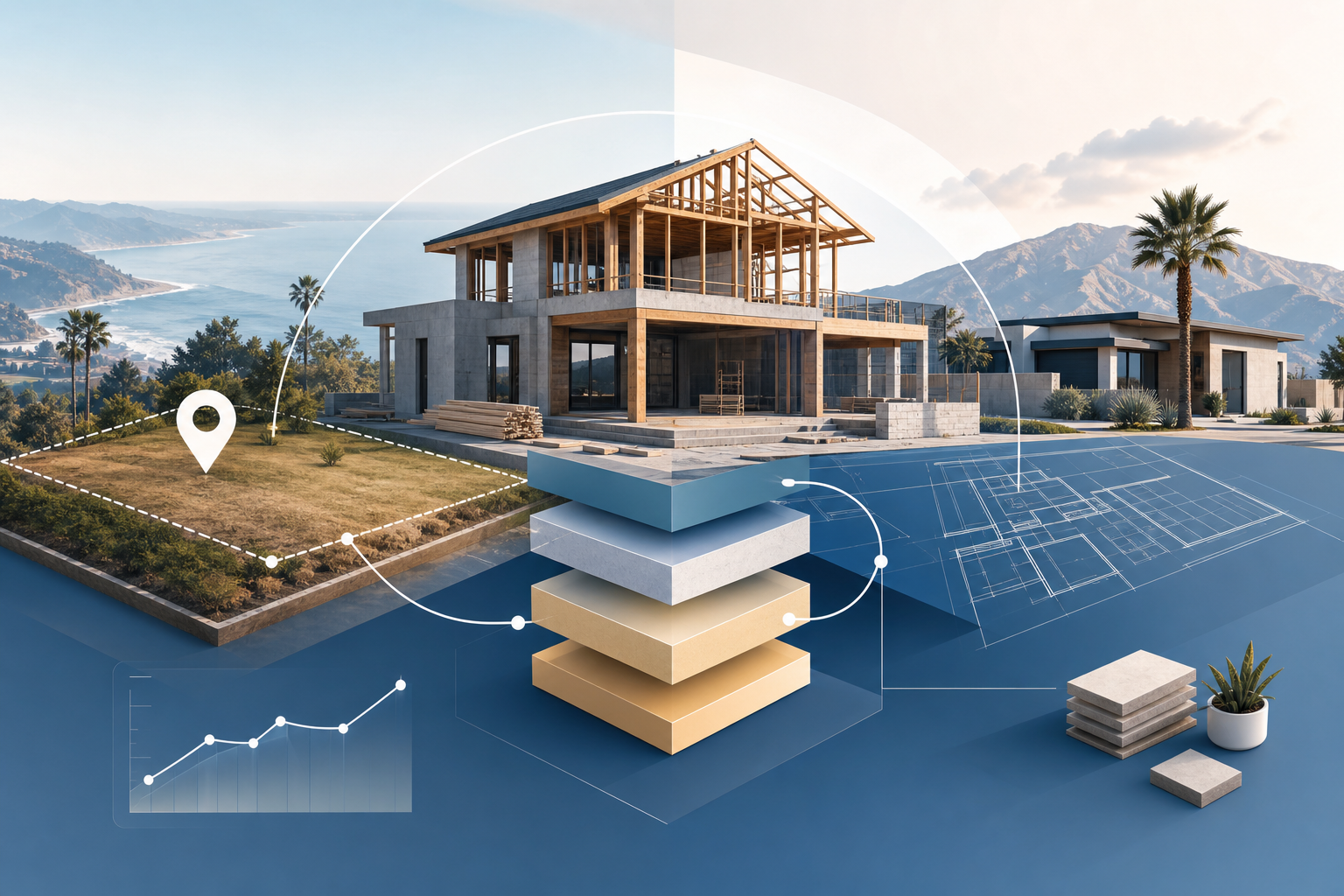
Yes. Some California lenders and brokers advertise financing that can cover both a lot purchase and construction, but the structure matters:
- Single-close construction-to-permanent financing: The land purchase, construction loan, and permanent mortgage are approved and documented as one transaction. The lender funds the lot acquisition at closing, then releases construction funds through approved draws.
- Land loan followed by construction financing: The borrower purchases the land with separate financing. When plans, permits, and the builder package are ready, a construction lender may refinance or pay off the land loan and fund the build.
- Short-term investor or builder financing: A business-purpose lender may finance the land or existing structure and vertical construction, with repayment expected through a sale, refinance, or longer-term rental loan.
These structures are not interchangeable. A lender that offers construction-to-permanent financing does not necessarily fund the land purchase at the same closing. Ask for written confirmation of the funding sequence, lien position, occupancy rules, builder requirements, and permanent-financing terms before signing a purchase contract.
California lenders and intermediaries that advertise these options
The companies below have different roles. The figures and program descriptions are advertised information, not loan commitments. They were reviewed on July 20, 2026, and programs, pricing, licensing status, eligible counties, and underwriting requirements may change.
| Company | Role and California status | What its public materials describe | Borrower or property focus | Land-and-construction closing issue |
|---|---|---|---|---|
| California Construction Loans | A brand affiliated with Nationwide Construction Loans, Inc.; its website describes access to a network of lenders and construction consulting rather than identifying the company as the direct funding source. | Advertises residential land loans and one-time-close construction-to-permanent loans. Its land-loan page says a later construction loan may pay off the land balance, depending on the borrower’s equity. | Primary residences and second homes on zoned residential sites; its broader materials also describe investor, spec, commercial, and hard-money programs. | The land-loan page describes a later payoff or refinance sequence, not necessarily a guaranteed combined closing. Its products page says combining the land purchase with construction requires approved house plans and a cost breakdown. (californiaconstructionloans.com) |
| Citizens Private Bank | A bank-affiliated private-banking and construction-lending group. It is not the same product as every consumer Citizens mortgage program. | Advertises an acquisition-to-construction-to-permanent product designed for the purchase of land or a home with a single close. It also describes construction-to-permanent financing for repayment of existing debt. | Large-scale or luxury homes; its page lists primary, secondary, and investment homes and identifies California markets including the Bay Area, Lake Tahoe, Los Angeles, Newport Beach, Pacific Palisades, San Diego, and Wine Country. | The Private Bank page expressly describes land purchase with a single close. That statement should not automatically be applied to Citizens’ consumer Build a Home program, which describes flexible lot options but does not, on the cited page, clearly promise that a new lot purchase is funded in the same closing. (citizensbank.com) |
| NexWin Capital Corp. | A California-licensed loan broker, not necessarily the direct lender for every transaction. Its site identifies NMLS ID 2743839 and DFPI license 60DBO-211586. | Brokers construction loans that may fund land or an existing structure plus vertical construction. Advertised examples include $250,000 to more than $10 million, 12- to 24-month terms, up to 85% LTC, and up to 70% LTV of after-repair value. | Non-owner-occupied construction, builder, investor, and developer scenarios; its materials reference California and nationwide lender placement and give an Orange County/Los Angeles example. | The site says the construction loan can fund land and vertical construction, but the borrower should confirm whether land acquisition occurs in the same closing, whether the lender requires a first deed of trust, and whether the transaction is business-purpose only. (nexwincapital.com) |
| Spreo Capital | A non-bank real estate lender. Its site states that California loans are made or arranged by licensed Spreo entities under California Finance Lenders Law licenses 60DBO-167629 and 60DBO-167661. | Advertises ground-up construction loans from $500,000 to $8 million, 12- to 24-month terms, up to 85% LTV, and financing for up to 100% of vertical costs. | Single-family and multifamily residential properties that are non-owner occupied, generally for investors and developers. | The public page lists purchase, refinance, and cash-out options but does not, by itself, establish that every loan includes land acquisition at the same closing. Confirm the eligible California counties and whether acquisition proceeds are included in the term sheet. (spreocapitalpartners.com) |
How to interpret advertised leverage
Advertised maximum leverage is not the same as an approved loan amount. LTC, LTV, and LTARV use different bases:
- LTC, or loan-to-cost, may be calculated against land, hard costs, soft costs, and other approved project expenses.
- LTV, or loan-to-value, is generally calculated against the property value used by the lender, which may be the current value or completed value.
- LTARV, or loan-to-after-repair-value, uses the appraised value after construction or renovation.
A lender may apply the lowest of several limits. For example, a project could satisfy an advertised LTC ceiling but still be limited by the completed appraisal, borrower liquidity, builder experience, reserves, or a required minimum equity contribution. All advertised figures above are subject to underwriting, appraisal, title review, property eligibility, and program availability.
The main structures for financing land and construction
1. Single-close construction-to-permanent financing
This structure generally involves one closing for a loan that covers the approved land acquisition, construction period, and permanent mortgage. Construction funds are usually placed under lender control and released through draws after inspections or other conditions are satisfied.
Potential advantages include:
- One underwriting process and closing instead of two separate transactions.
- A permanent rate that may be locked before construction, depending on the program.
- Less exposure to the risk that a future construction lender changes its criteria.
- A clear conversion or completion process after the certificate of occupancy or other required milestone.
Potential limitations include:
- The borrower may need final plans, specifications, a detailed budget, an appraisal, and an approved builder before closing.
- The lender may require the parcel to be buildable, properly zoned, accessible, and adequately served by utilities.
- The borrower may be locked into the lender’s permanent-loan terms before construction is complete.
- A failed permit, appraisal revision, builder-approval issue, or construction delay can prevent or delay funding.
2. Land loan followed by construction financing
The borrower closes on the parcel first. Later, after plans, permits, budget, and builder approval are ready, a construction lender funds the build and may pay off the land loan.
This can work when the borrower needs to secure the parcel before the project is fully designed. However, it creates additional risks:
- The future construction lender may not approve the parcel or project.
- The borrower may pay land-loan interest while plans and permits are prepared.
- The later loan may require a new appraisal, title review, credit review, and closing costs.
- The land lender’s payoff amount may not fit within the construction lender’s leverage limits.
- A delay can create maturity, extension-fee, or refinance risk.
California Construction Loans specifically describes a land loan that may later be paid off by the construction-to-permanent loan, depending on the borrower’s equity. That wording supports a sequential financing structure; it should not be treated as proof that every borrower receives a single combined closing. (californiaconstructionloans.com)
3. Short-term ground-up construction financing
Business-purpose construction lenders and brokers may structure a short-term loan around the total project cost and expected completed value. The loan may include land acquisition, payoff of an existing land loan, site work, and vertical construction, but the exact proceeds and lien structure must be stated in the term sheet.
This structure is more commonly relevant to:
- Spec-home builders.
- Investors building for sale.
- Developers constructing non-owner-occupied single-family or multifamily property.
- Borrowers planning to refinance into a rental or permanent loan.
The expected exit is usually a sale, refinance, or permanent rental loan. A borrower should not assume that an investor construction loan is suitable for a primary residence or that consumer protections and documentation requirements will be the same.
Owner-occupied custom homes versus builder and investor projects
| Issue | Owner-occupied custom home | Non-owner-occupied builder or spec project |
|---|---|---|
| Typical borrower | Individual or household building a primary residence or second home | Builder, investor, developer, LLC, partnership, or other business-purpose borrower |
| Typical structure | Single-close construction-to-permanent or land loan followed by construction-to-permanent financing | Short-term ground-up, acquisition-and-development, bridge, or construction loan followed by sale or refinance |
| Builder requirements | Lender approval of the general contractor; owner-builder exceptions may require a licensed contractor or documented experience | Experience with completed projects, budgets, exits, and sometimes a licensed general contractor or construction manager |
| Repayment or exit | Conversion to a permanent mortgage after completion | Sale, refinance, DSCR or rental loan, or another permanent commercial/residential loan |
| Likely documentation | Income, assets, debts, credit, plans, specifications, builder contract, budget, appraisal, insurance, and reserves | Entity documents, personal financial statement, tax returns or financials, plans, budget, schedule, builder resume, permits, market analysis, liquidity, and exit strategy |
| Occupancy | Primary residence or second home, if permitted by the program | Usually non-owner occupied; verify this before applying |
| Key underwriting emphasis | Ability to qualify for the permanent mortgage and complete the home | Project feasibility, experience, leverage, contingency reserves, completed value, marketability, and exit |
Do not use advertised investor terms to estimate what an owner-occupied borrower can obtain. Conversely, a consumer construction-to-permanent product may not support a spec-home sale, an LLC borrower, or a multifamily project.
Does land equity count toward the down payment?
It may. Some lenders may recognize contributed land value as part of the borrower’s equity, usually based on the land’s accepted appraised value and reduced by existing liens. The lender may also review how long the borrower has owned the land, the purchase price, documented improvements, title history, and whether the land was acquired with borrowed funds.
The calculation varies by program. A lender might use:
- Current appraised land value.
- The borrower’s net equity after paying off a land loan.
- Documented land acquisition costs or prepaid project costs.
- A combined LTC and completed-value test.
California Construction Loans states that recent payments toward a lot purchase and certain prepaid hard or soft costs may be considered toward equity when properly documented, but that is a lender-specific program statement, not a universal rule. Ask whether the lender requires seasoning, a new appraisal, a first-lien position, or a minimum amount of cash in addition to land equity. (californiaconstructionloans.com)
California parcel and construction due diligence
A lender’s approval does not replace the borrower’s own feasibility review. Before closing on land, investigate:
- Zoning and permitted use: Confirm that the parcel allows the intended residence, number of units, accessory dwelling units, or spec-home use.
- Access and easements: Verify legal and physical access, recorded easements, road maintenance, driveway rights, and utility easements.
- Water and septic: Determine whether the site has a reliable water source, a water meter, a well permit, sewer access, or adequate soils for a septic system.
- Geotechnical conditions: Review slope stability, landslide risk, expansive soils, grading needs, retaining walls, foundation requirements, and seismic considerations.
- Wildfire exposure: Check defensible-space requirements, fire access, insurance availability, brush-management obligations, and whether the lender accepts the available policy terms.
- Flood and drainage: Determine whether flood insurance is required, whether the parcel lies in a mapped flood area, and whether drainage or storm-water improvements are needed.
- Coastal, hillside, and environmental restrictions: Coastal permits, hillside ordinances, habitat restrictions, wetlands, protected trees, and environmental review can affect timing and cost.
- Agricultural or conservation limitations: Williamson Act contracts, conservation easements, habitat protections, and agricultural zoning may restrict development or financing.
- Jurisdiction-specific permitting: Requirements differ among cities and counties. Confirm the status of planning approval, building permits, grading permits, septic approval, utility commitments, and any subdivision or parcel-map conditions.
- Insurance and title: Obtain preliminary title, identify liens and restrictions, and confirm that builder’s risk, liability, flood, and wildfire-related coverage will be available at closing and during construction.
A parcel that appears inexpensive may be difficult to finance if it lacks utilities, has uncertain access, requires substantial grading, or cannot obtain acceptable insurance.
A practical decision framework
Use this sequence before comparing rates:
1. Identify occupancy and exit. Decide whether the project is a primary residence, second home, rental, or home built for sale. Owner-occupied and business-purpose programs are usually underwritten differently.
2. Confirm parcel eligibility. Verify zoning, access, utilities, water, septic, wildfire and flood exposure, easements, and local permitting requirements.
3. Prepare plans and budget. Assemble plans, specifications, a line-item construction budget, site-work estimates, contingency, construction schedule, and expected completion date.
4. Verify builder approval. Ask each lender about contractor licensing, insurance, experience, contract form, retainage, inspections, and owner-builder exceptions.
5. Compare one-close and two-close costs. Include origination charges, appraisal and inspection fees, title work, land-loan interest, extension fees, unused-fund fees, draw fees, rate-lock costs, and the cost of a later refinance.
6. Request a written term sheet. Require the term sheet to identify the land-acquisition proceeds, first-lien requirements, total loan amount, leverage calculation, draw schedule, reserves, maturity, conversion terms, extension provisions, and exit requirements.
Costs and risks borrowers often overlook
Combined financing can simplify the transaction, but it does not eliminate construction risk. Review:
- Interest charged on land-loan debt before construction begins.
- Extension fees if permits or construction take longer than expected.
- Unused construction-fund or loan-commitment fees.
- Inspection, draw, wire, fund-control, and construction-management fees.
- Lender-controlled accounts and limits on paying contractors directly.
- Rate-lock expiration, lock-extension charges, and the date the permanent rate becomes fixed.
- Appraisal revisions if plans, specifications, costs, or market conditions change.
- Required interest, tax, insurance, and contingency reserves.
- The possibility that a permit delay or builder-approval issue postpones the construction closing or conversion.
- The risk that the completed property appraises below the projected value, requiring additional cash or a smaller loan.
Questions to ask a California lender or broker
Ask for clear written answers to these questions:
- Will the initial closing fund the land purchase, or must I close a separate land loan first?
- If I already own the land, how will its value and liens be treated as equity?
- Is the loan secured by a first deed of trust from the beginning?
- Is a second closing required when construction starts or when the loan becomes permanent?
- Will the construction loan pay off the land loan automatically, or only if the new underwriting approves the payoff?
- What costs are eligible: land, plans, permits, grading, utilities, septic, landscaping, contingency, interest carry, and vertical construction?
- How is leverage calculated: purchase price, total cost, current value, completed value, or the lowest of multiple tests?
- What builder experience, license, insurance, and contract requirements apply?
- How many draws are allowed, who controls the funds, and what inspections are required?
- Are extension fees, unused-fund fees, draw fees, or prepayment penalties charged?
- Is the program available for a primary residence, second home, rental, spec home, or multifamily property?
- Which California counties and property types are currently eligible?
- What permanent loan or sale/refinance exit must be approved before closing?
- What happens if permits, construction, or the appraisal are delayed?
Frequently asked questions
Are there California lenders that combine land acquisition and construction financing in one closing?
Yes, some lenders advertise single-close acquisition-to-construction-to-permanent products. Citizens Private Bank expressly describes a single-close product for purchasing land or a home and then financing construction. California Construction Loans also advertises one-time-close products, but its separate land-loan materials describe a later construction loan paying off the land balance. Confirm the exact closing structure in the written commitment. (citizensbank.com)
Can land equity count as my down payment?
Possibly. A lender may count net land equity—appraised value minus liens—toward the required contribution, subject to appraisal, title, seasoning, documentation, and program-specific LTC or LTV limits. Additional cash reserves may still be required.
Can an owner-occupied borrower qualify?
Yes, if the selected program permits a primary residence or second home and the borrower meets income, credit, asset, appraisal, builder, and permanent-loan requirements. Investor programs for non-owner-occupied construction should not be assumed to apply to a custom home the borrower will occupy.
Can land and construction close simultaneously?
Sometimes. A single-close loan can fund the lot purchase at closing and place the remaining construction proceeds under draw control. Other programs require the borrower to buy the land first and later refinance or pay off the land debt with construction financing. Ask specifically whether acquisition proceeds appear in the initial closing disclosure and loan commitment.
Does a construction loan automatically include the lot purchase?
No. The loan documents must authorize land acquisition or payoff of an existing land loan. Some construction loans are limited to vertical construction on land the borrower already owns.
Do construction lenders require a first lien?
Many lenders require a first deed of trust so their loan has priority against the property, but the requirement and timing depend on the structure. If a land loan remains outstanding, the construction lender may require payoff, subordination, or another approved arrangement. Obtain the lien-position requirement before closing the land loan.
What if I do not have final plans or a builder yet?
A separate land loan may be more practical, but it creates future financing risk. A single-close lender may require approved plans, a detailed budget, a builder contract, appraisal, and other construction documents before funding the land purchase.
Are the advertised loan amounts and leverage percentages guaranteed?
No. Figures such as 85% LTC, 70% LTARV, 85% LTV, or financing for 100% of vertical costs are advertised program limits or examples. The approved amount may be lower because of the appraisal, total project cost, borrower liquidity, credit, experience, property location, insurance, reserves, or lender concentration limits.
What information should I provide to get matched with a suitable program?
Provide your intended use and occupancy, parcel status, purchase price or current land value, county, construction budget, plans and permit status, builder status and experience, estimated completion timeline, credit and liquidity profile, and intended sale or refinance exit. That information helps a lender or broker determine whether a single-close, sequential, or short-term investor structure is appropriate.
Request a project-specific review
If you are comparing California land and construction financing, prepare these details before contacting a lender or broker:
- Intended use: primary residence, second home, rental, or spec home.
- Parcel status: land to be purchased, land already owned, or land with an existing loan.
- County and jurisdiction.
- Purchase price or current appraised land value.
- Estimated hard costs, soft costs, site work, contingency, and total construction budget.
- Plans, permits, utility, water, and septic status.
- Builder or general-contractor name, license, insurance, and relevant experience.
- Estimated construction start and completion dates.
- Expected exit: permanent mortgage, sale, rental refinance, or another payoff source.
A lender or broker can then determine whether the project is better suited to a single-close acquisition-to-construction-to-permanent loan, a land loan followed by construction financing, or a short-term ground-up loan. Request a written term sheet and verify the company’s licensing, direct-lender or broker role, eligible counties, lien position, fees, and current program terms before proceeding.
References
- https://www.citizensbank.com/loans/build-a-home.aspx
FAQ
Are there California lenders that combine land acquisition and construction financing in one closing?
Yes. Some lenders advertise single-close acquisition-to-construction-to-permanent products, while others require a separate land loan that is later refinanced or paid off by construction financing. Confirm the exact funding sequence in the written loan commitment.
Can land equity count as my down payment?
Possibly. A lender may recognize net land equity after liens, subject to appraisal, title, seasoning, documentation, reserves, and the program’s LTC or LTV calculations.
Can an owner-occupied borrower qualify?
Yes, if the program permits a primary residence or second home and the borrower meets its income, credit, asset, appraisal, builder, and permanent-loan requirements. Investor construction terms may not apply.
Can land and construction close simultaneously?
Sometimes. A single-close loan may fund the land at the initial closing and release construction funds through draws. Other programs require the borrower to buy the land first and obtain construction financing later.
Does a construction loan automatically include the lot purchase?
No. The loan documents must specifically authorize land acquisition or payoff of an existing land loan. Some construction loans only finance building on land the borrower already owns.
Do construction lenders require a first lien?
Many do, but requirements vary. Ask whether the lender requires a first deed of trust from the initial closing and how any existing land loan will be handled.
Are advertised leverage limits guaranteed?
No. Advertised LTC, LTV, and LTARV limits are maximums or examples subject to appraisal, underwriting, borrower liquidity, property eligibility, reserves, builder experience, insurance, and program availability.